Untersuchungen über einige Spurenelemente in Seen
[Investigations of some trace elements in lakes]
Groth, Peter
Archiv für Hydrobiologie Volume 68 Number 3 (1971), p. 305 - 375
72 références bibliographiques
publié: Apr 5, 1971
Abstract
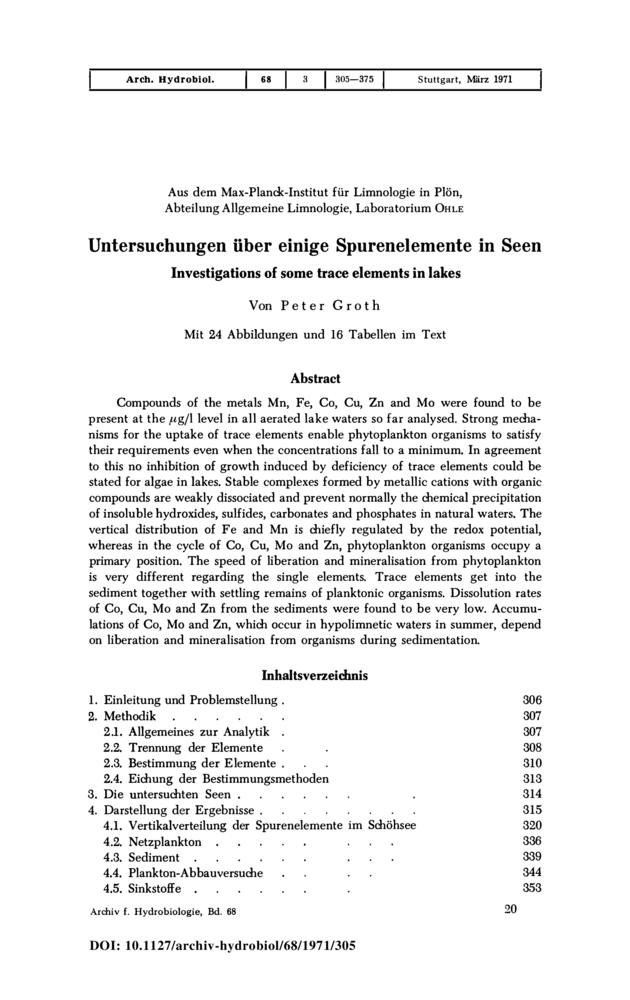
Compounds of the metals Mn, Fe, Co, Cu, Zn and Mo were found to be present at the µg/l level in all aerated lake waters so far analysed. Strong mechanisms for the uptake of trace elements enable phytoplankton organisms to satisfy their requirements even when the concentrations fall to a minimum. In agreement to this no inhibition of growth induced by deficiency of trace elements could be stated for algae in lakes. Stahle complexes formed by metallic cations with organic compounds are weakly dissociated and prevent normally the chemical precipitation of insoluble hydroxides, sulfides, carbonates and phosphates in natural waters. The vertical distribution of Fe and Mn is chiefly regulated by the redox potential, whereas in the cycle of Co, Cu, Mo and Zn, phytoplankton organisms occupy a primary position. The speed of liberation and mineralisation from phytoplankton is very different regarding the single elements. Trace elements get into the sediment together with settling remains of planktonic organisms. Dissolution rates of Co, Cu, Mo and Zn from the sediments were found to be very low. Accumulations of Co, Mo and Zn, which occur in hypolimnetic waters in summer, depend on liberation and mineralisation from organisms during sedimentation.
Mots-clefs
phytoplankton organism • redox potential • chemical precipitation • mineralisation • dissolution rates • hypolimnetic waters • metallic cations • Schöhsee • Plußsee • Trammer See • Ratzeburg • Norddeutschland